![]() |
| EUrope |
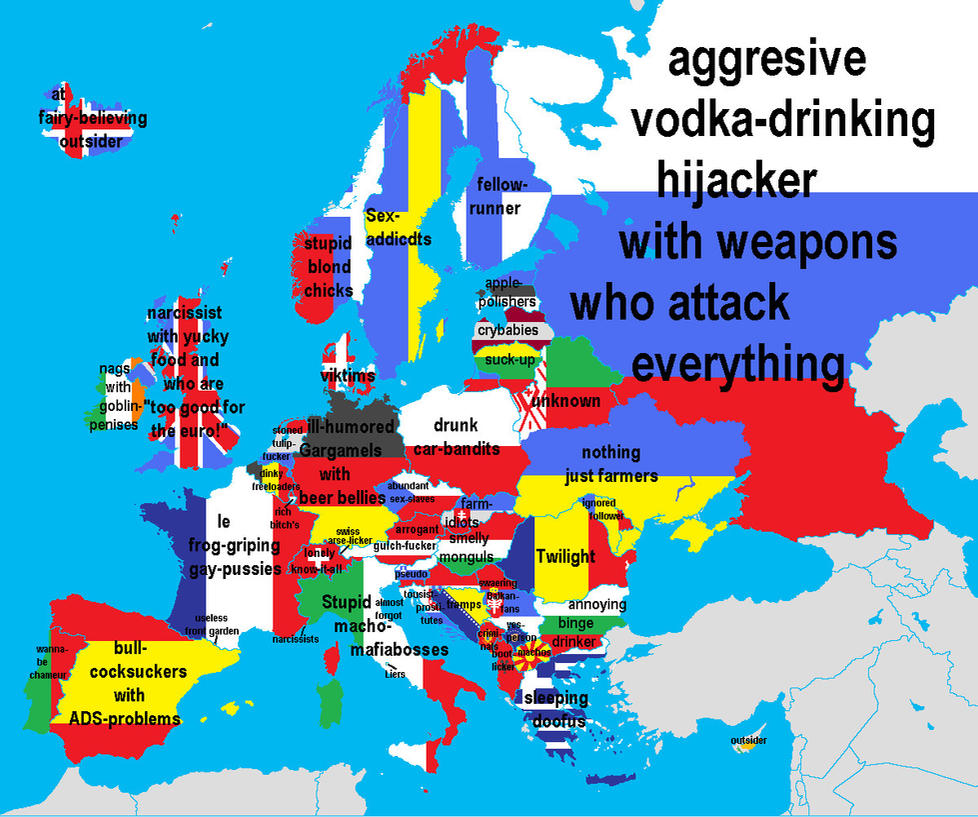
This is a basic backgrounder for
Americans, primarily, who might think Europeans do nothing all day but
bitch about Americans. Don’t get me wrong—they do love bitching about
Americans. But they also like bitching about each other, as well.
Bordering countries, especially, have complex caricatures of each other,
even when an outsider might think they’re more or less the same. The
following is based on my numerous interactions with Europeans, having
lived there for 4 years. Here’s a run down:
The French —
Disliked by some Spanish (particularly the Catalonians), for being
arrogant. One woman from Barcelona told me, “Come on¦who really likes
the French? Nobody!” The Swiss don’t like the fact that they have
contempt for authority and are lazy. The Brits, of course, have the most
mixed feelings about the French, though. One half the country hates
them, the other half loves them. Those that hate the French tend to like
the Americans, and vice versa. In the UK, they’re considered stinky,
rude (they never line/queue up like decent people), and a bit yellow,
based on their tendency to not fend off invaders like the Nazis.The
French, in turn, dislike the British, look down on Belgians for being
stupid, and don’t have much to say, in my experience, about Spaniards or
Germans (oddly).
The Italians —
Most of the stereotypes are positive, but mostly because of the food.
Northern Europeans consider them lazy and flaky, and maybe incapable of
managing anything right (mostly because of the 50+ governments they’ve
had since WW2). One Dutch professor I had dismissed another Italian one,
saying, “All the Italians care about are pasta and mamma.”Italians, in
turn, don’t have strong feelings about other Europeans, but within
Italy, the north-south divide is pretty strong. Northern Italians
continuously complain that Southerners are lazy and unproductive, while
Southerners complain that Northerners are devoid of culture or joie de
vivre.
The Germans —
Germans are considered industrious but uptight and humorless, by just
about all the other Europeans. They know WW2 is a sore spot for them, so
other Europeans will often mercilessly tease them about it. As much as
Germany is considered an economic powerhouse, the vast majority of
Europeans don’t really want to learn German or study there (or send
their kids there to study). The food is considered uninspired, too, and
only Berlin has some cachet among younger Europeans for its vibrant
underground club scene. The most anti-German sentiments are among the
Dutch and Danish, who just hate them from invading their countries too
often. When German ask for directions in Holland, they’re usually given
directions to the shortest way out of the country, or told “Give us back
our bikes!”, a reference to the fact that Germans confiscated Dutch
bicycles during WW2.Danes hate it when you pronounce their capital as
“ko-pen-HAH-gen”, because this is the German pronunciation. Either
pronounce it the English way (with “HAY” instead), or the Danish way,
which is literally impossible to put down here.Germans tend to like
their Western neighbors far more than they are liked by them, but they
look down on their Eastern neighbors, particularly Poles. They, oddly,
have some mixed respect for the Czechs, who have resisted German
aggression.
The Scandinavians —
Widely respected by most other Europeans, because of their high
standard of living …and blond hair and blue eyes. However, within
Scandinavia there are some persistent stereotypes. The Norwegians, Danes
and Finns all think the Swedes are stupid and uptight. Norwegians are
considered racist. Danes are considered more blunt than the others,
maybe a bit more cranky, and the Finns are oddly introverted, even by
Scandinavian standards. Except for the Danes really disliking Germans,
and Finns really disliking Russians, they don’t really have anything
against other Europeans.
The Belgians —
Considered idiots by both the Dutch and the French. Belgians, in turn,
consider the Dutch to be a bunch of cranky assholes, and French
stuck-up.
The Dutch —
The Dutch, like the Scandinavians, have an enviable economy and social
order that’s admired by southern European countries. However, they do
have a reputation of being self-righteous “know-it-alls” and very
similar to their German cousins in terms of their rigidity. But they do
not like any comparisons to Germans, and if you remind them that the
Dutch national anthem makes a reference to the Dutch being “van Duitse
bloed” (from German blood), you might quickly get the silent treatment.
The Dutch are also disliked for being the biggest misers in Europe, and
because of this they incur the wrath of the tourist industry wherever
they travel. The Dutch have been known to stock up on water before they
take their campers down to the south of France.The Dutch, in turn, kind
of look down on just about everyone. Yes, there’s a bit of a reason for
the “know-it-all” smart-ass reputation they have.
The Swiss —
Considered extremely rigid, even by the Germans. Blunt to the point of
being rude, the Swiss probably have the least likely reputation for
being characterized as “friendly” or “warm”. Note that there is a big
cultural divide between French-speaking Swiss, and the German-speaking
Swiss. The former are almost exactly like the French, except having a
blander cuisine and more respect for authority, the latter being more
like the Germans except even more stiff, rigid and cranky. However,
everyone knows Switzerland “works” so the fact that foreigners comprise
20% of the population (mostly from EU member states) should make this
clear.Note that the German-speaking Swiss also speak their own variant
of German, which sounds very strange if you’ve only been exposed to
standard “hoch-Deutsch”.
The Spaniards —
Honestly, very little antagonism against the Spanish or by the Spanish.
No one really seems to dislike them, and they don’t seem to really
dislike anyone else. (Yes, some Spaniards near the border to France
don’t like the French very much) Not entirely sure why. However, God
forbid you speak Spanish with a Latin American accent — there is still a
lot of snobbery among Spaniards towards Latin Americans. Spaniards
consider themselves white and European, and would be deeply insulted if
you suggested they were Latin American of any kind.
The Greeks —
Only nominally considered European by other Europeans, but the Greeks
fiercely identify as European. Naturally, this is a huge irritant to
Greeks.
The Poles —
Not much seems to register about Poland and the Poles except that
they’re quiet. They are a relatively big country (40 million people) so
the supposed scare of being overrun by Eastern Europeans when a bunch of
Eastern European countries joined the EU in 2005 focused in on the
Poles. The Germans really don’t like Poles, and among Germany’s 9
neighbors, are disliked the most. Poland is considered a country of car
thieves by the Germans. Really, the relationship between Germany and
Poland is similar to that of the United States and Mexico, and often for
many of the same reasons (differences in income, history of war,
different languages, etc.).Poles really shore up their hatred for their
eastern & southern neighbors, primarily Russia and Ukraine, although
they don’t like Czechs, Slovaks or Lithuanians either. Oddly, they
don’t really mind the Germans, and probably still fear them a bit — you
never, ever hear jokes about Germans in Poland.
The Czechs —
Considered a relatively bright spot of Eastern Europe by Western
Europeans, but I think primarily because Prague is such a gorgeous city
and a popular tourist destination. Czechs are a bit like Germans, though
— a bit rude, blunt, and cold. Poles don’t have much good to say about
them.
The Austrians —
Considered a mix of the best & worst aspects of Germany and the
Balkans, Austrians are considered laid-back but very nationalistic and
racist. They’re said to be the birthplace of Hitler, but never came
around to being fully apologetic about the Holocaust (unlike Germany).
Neutral feelings from most ofWestern Europe, negative feelings from
Germans (who consider them backwards, and not always the representing
the best image of German-speaking people) and admired by Eastern
Europeans (a throwback to the Hapsburgs).
The British –
About half of the British would be really angry at being called
European, so that should provide an apt starting point. The main beef
with the Brits is that they’re considered the lapdog of the U.S., and
are anti-European because the U.S. tells them to be so. They are
considered polite, but maybe a bit two-faced (hence “Janus Britain”) and
snobby. The Scots and Welsh are tolerated and liked, inasmuch as that
no one really knows too much about them outside the UK, but the English
are those that bear the brunt of negative sentiments among other
Europeans. After all, London is in England.
The English also have a poor reputation in tourist traps, such as Amsterdam and Ibiza, for being loud-mouthed, obnoxious drunks.
The English, in turn, really seem to hate everyone. This is because it’s pretty hard to find an Englishman that has even, at best, neutral opinions about other Europeans (or Americans, or other nationalities). Europe is full of English expats, and the longer they live abroad, the more they seem to hate their host country. And yet they never seem to want to move home.
The Irish —
A very small country, despite its exaggerated importance in Americans’
minds (just over 3 million) but considered polite and humble. They
nominally dislike the English, but I have yet to meet an Irishman who
really loathes the English. The sentiments towards the Irish and by the
Irish seem to be positive, overall.
I personally don’t know much about how the Portuguese, Hungarians, Romanians, Bulgarians, and others are perceived, or how they perceive others, but if you have something to add, please do so in the comments below.
I’ll leave you with this poster I saw in an Italian office years ago, that helps sum it up in some ways:
In Heaven…
- the mechanics are German
- the chefs are French
- the police are British
- the lovers are Italian
- and everything is organized by the Swiss.
In Hell…
- the mechanics are French
- the police are German
- the chefs are British
- the lovers are Swiss
- and everything is organized by the Italians.
Cheap Loan Rates UK - Bad Credit Rating?
Online Loans £50 to £1000
Very Cheap Car Insurance
Geld lenen bij Freo, Leningen in hypotheek
100% Kredit - Auszahlung, Günstiger Online-Kredit, Günstige KFZ-Versicherung
Günstiger Kredit der DKB, Auto Versicherung, Autoversicherung VERIVOX
Günstige Versicherung Auto
Lån 100.000 kr. Billigt - Få krav: Min. 20 år og ingen RKI, Trenger du boliglån?
Find billigste forsikring - Få 3 forsikringstilbud GRATIS her
Jämför Försäkring Försäkringar hos If, Folksam Försäkring - Hur är du försäkrad?
Låna pengar - Svar direkt - Låna mellan, Jämför lån hos Advisa
Søk lån, få svar straks - Lån fra 5.000 til 500.000 kroner, Spar penger på forsikring
Kattavat vakuutukset If Vakuutus - Kaikki vakuutukset nyt -10 % - if.fi
3000 € Laina - Nopea lainapäätös, Fiksumpi & Reilumpi Laina
200 participants, 50 countries, 5 continents, May 21-28 in Yerevan, Armenia.
So, you are already applying to:
- Meet diverse group of young leaders: from New Zealand to Mexico, from Sweden to South Africa;
- Debate on the challenging topics with peers from all over the world;
- Be part of Euro village hosted in 18th century building and Euro Concert hosted in one of the oldest concert halls in the South Caucasus region;
- Visit world's longest ropeway connecting a mountain chain to a 9th century UNESCO Heritage Monastery;
- Take the advantage of Committee Dinner at the Factory of Carpets dating back to 1900;
- Be recognized the best delegate during the Forum and get partial travel reimbursement;
More details are here: iefa.eyparmenia.org
It is our great pleasure to inform you that the 2nd International EYP Forum in Armenia (IEFA 2015) on «Democratic Citizenship: obtaining, developing, empowering» (DECODE) will take place on 21st May – 28th May, 2015 in Yerevan, Armenia. Around 200 delegates from more than 50 countries of Europe, Asia, Africa and Americas will come together for this eight-day program to discuss the specified topic in the respective committees. We are happy now to open the call for Armenian and International Delegates for the upcoming Forum.
You consider applying to:
❖ Meet 200 participants from 50 countries of Europe, Asia, Africa and Americas;
❖ Discover Armenia, 1st country to adopt Christianity as official religion in 301 A.D.;
❖ Visit world’s longest ropeway in the scope of IEFA;
❖ Be part of big-scale Cultural Festival in the scope of Republic Day celebrations on May 28th;
❖ Debate on daring and urgent topics not only with Europeans.
❖ Discover Armenia, 1st country to adopt Christianity as official religion in 301 A.D.;
❖ Visit world’s longest ropeway in the scope of IEFA;
❖ Be part of big-scale Cultural Festival in the scope of Republic Day celebrations on May 28th;
❖ Debate on daring and urgent topics not only with Europeans.
The official trailer of the event can be found here: http://bit.ly/1rW0OGU
Here previous participants of the Forum share their experience: http://bit.ly/1BYrr1f
Information package can be found here: http://bit.ly/1xdmRGN
Here previous participants of the Forum share their experience: http://bit.ly/1BYrr1f
Information package can be found here: http://bit.ly/1xdmRGN
You can find more information on the International EYP Forum in Armenia (IEFA) here: www.iefa.eyparmenia.org
The application deadline is March 26, CET 23:59
The
Henley & Partners Visa Restrictions Index is a annual global
ranking of countries according to the travel freedom that their citizens
enjoy.
They
analyze the visa regulations of all countries and territories in the
world and present an index which ranks each by the number of other
countries that their citizens can travel to without having to obtain a
visa.
The country with the highest score achieved, are ranked in first position.
The Henley & Partners Visa Restrictions Index is a annual global ranking of countries according to the travel freedom that their citizens enjoy.
They analyze the visa regulations of all countries and territories in the world and present an index which ranks each by the number of other countries that their citizens can travel to without having to obtain a visa.
The country with the highest score achieved, are ranked in first position.
1. 174 Points
Finland
Germany
Sweden
USA
United Kingdom
2. 173 Points
Canada
Denmark
3. 172 Points
Belgium
France
Italy
Japan
South Korea
Luxembourg
Netherlands
Portugal
Spain
4. 171 Points
Austria
Ireland
Norway
5. 170 Points
New Zealand
Singapore
Switzerland
6. 169 Points
Greece
7. 168 Points
Australia
8. 166 Points
Malaysia
Malta
9. 165 Points
Iceland
10. 162 Points
Czezh Republic
Hungary
Training Course: MENTOR plus – Improving mentorship in EVS
Dates: 20-24 April 2015
Venue: Vienna, Austria
Eligible are 24 participants coming from: YOUTH IN ACTION PROGRAMME COUNTRIES
Application deadline: 27th February 2015
The
main aim of the training is to increase the quality of mentoring in EVS
and to support active mentors working with their volunteer(s).
Description
You are active as a mentor within EVS? You are about to become a mentor
in EVS? You have been a mentor in EVS for some time and feel the need to
reflect on your role, your responsibilities and challenges? You are
ready to share your experiences, get to know other people and new
practises and methods? Go and apply now!
Aims and objectives:
The overall aim of this activity is to increase the quality of mentoring
in EVS and to support active mentors working with their volunteer(s).
This should be fostered through:
– increasing the knowledge about mentoring in EVS, basic knowledge in EVS in general and about the framework Programme Erasmus+: Youth in Action
– developing a common understanding of mentoring within EVS
– reflecting about roles, responsibilities, challenges and needs concerning mentorship in EVS
– sharing best practice and tools for supporting EVS volunteers
Who?
This training activity invites active mentors (newcomers that are
already involved in an ongoing project as well as experienced mentors)
that feel the need of developing their competences further and improving
the quality of their mentorship.
What?
This training activity offers the opportunity to further develop
competencies that are needed as a mentor within EVS. There will be time
to reflect on the roles, responsibilities and challenges of actors
involved in Mentoring, to share experiences and to get to know about other people´s practices.
The educational approach of the training activity is based on non formal
education methods and experiential learning as well as the contribution
of participants and on active participation in all parts of the
programme.
Working language will be English – participants need to be willing and
able to actively participate and communicate in English throughout the
whole activity.
Costs
this project is financed by the Erasmus+ Youth in Action Programme.
Being selected for this course, all costs (accommodation, travel, visa,
etc.) relevant to participation in the course will be covered by the NAs
involved in this project – except a participation fee which varies from
call to call and country to country. Please contact your NA to
learn more about the financial details, and how to arrange the booking
of your travel tickets and the reimbursement of your travel expenses.
Application
Organizer:
Interkulturelles Zentrum
Co-organizer:
Spanish National Agency
Contact for questions:
Elisabeth Jogna
E-Mail: elisabeth.jogna@iz.or.at
Phone: 0043 1 5867544 13
For additional information please see the official call.
We think about cost of living all the time, especially when we're looking to move from one location to another. Our perspective is, therefore, generally rather narrow.
The folks at Movehub.com have compiled some awesome data that forces us to take a look at the entire world.
This is an infographic on the cost of living all around the world. When you look at the data, presented in this way, the results are a bit staggering.
For example, the top three countries for cost of living are Switzerland, Norway, and Venezuela. The bottom three are India, Nepal, and Pakistan.
JENNIFER BUI
As most of our stories do, this began as an argument. Liz was espousing the virtues of Georgian food, which I had summarily dismissed, and then, during the following geeky discussion of random countries' cuisines, we began to wonder how each part of Europe stacked up against the others.
And so we dug into the countries (between us, we’ve visited 39 of 48 on the list) and came up with rules: the biggest factor had to be the indigenous cuisine (in other words, Ireland doesn’t get extra credit just because Dublin has a spectacular Indian restaurant), the food and drink culture within its cities and towns, and the variety that exists within each place. Sure, some countries may cook up one thing extraordinarily well, but what else can they do? As my Grandfather used to say, just because you can juggle doesn’t mean you can dance. Gastronomically speaking, we want the places that can juggle AND dance. And maybe cook too.
As with anything that exists on the Internet, we will have missed some dishes or failed to point out a key component in blood soup or made horrible Hungary puns. And we apologize and trust you will keep us honest in the comments. But until then, strap in, because you are about to go on a whirlwind culinary tour. Maybe try and avoid the scurvy grass.
[Editor's note: These are the countries in Europe, according to the CIA World Factbook.]
48. Vatican City
The one restaurant in Vatican City quickly puts an end to the rumor that you can only eat at Communion, and Rome is sitting there, right outside, waiting with fresh cacio e pepe, but, still... the country has one restaurant. Give Pope Francis some options!
47. Faroe Islands
If you get tired of eating skerpikjøt, they have something called scurvy grass, “whose sour leaves can compensate for the lack of fresh vegetables.”
MORE STUFF YOU WILL LIKE
SHUTTERSTOCK / JENNIFER BUI
46. Montenegro
While they do have Njeguška pršuta, which is essentially their version of prosciutto, and is delicious, they’re also big fans of not-so-delicious clear fish soups and smoked bleak, which sounds like a depressing murder mystery, but is actually a fish in the carp family. UNLESS THAT’S JUST WHAT THE REAL MURDERERS WANT YOU TO THINK!45. Andorra
The food here is good! French and Spanish cuisine. Problem is -- it’s all imported, and not their own original food, so... you don’t get credit for that.44. Monaco
If you could eat untaxed income, Monaco would be a lot higher on this list. But you can’t, so Monaco is not very high on this list.43. Liechtenstein
I went to this country in 2007 to get the fancy fake passport stamp they make available. And then I ate Thai food. And while Liechtenstein is lovely, mostly all of their food -- save hafalaaban (soup with ham and cornmeal dumplings!) -- comes from other countries, and so we must invoke a partial Andorra clause.42. Ukraine
We really wanted to put Ukraine higher, because we’re full of compassion what with all of the problems with Russia, but all that jellied meat and fermented rye bread kvass and sour milk drinking... we just can’t. I’m sorry.41. Kosovo
In the food and drinks section of BeinKosovo.com, under traditional food, there is nothing. Same for drinks. On another site, they point out that people in Kosovo now eat French toast. But they seem to have burek, flija, and all sorts of spinach pies, and Šarski cheese is relatively famous, so we’ll just assume that the web admin for BeinKosovo just got lazy updating the site.WESTENDER / JENNIFER BUI
40. Iceland
The land of frozen water’s cuisine was made famous by an episode of Anthony Bourdain’sNo Reservations, where he has a very hard time eating that fermented shark. But that’s not all those Icelanders have to dine on! Feast your eyes and mouth on minke whale or air-dried fish & butter... or, um, puffin. And then wash it all down with their unsweetened schnapps beverage Brennivin, Einstök pale ale in cool bottles, and late-night dogs from that one famous hot dog stand often frequented by Americans on bachelor parties.39. Estonia
As they say, “come for the Baltic dwarf herring, stay for the smoked eel and sprats.”38. Luxembourg
First off, they do make their own wine and have several breweries, so golf-clap for that. But no golf-claps for basically just eating German, French, and Belgian foods, even if they are delicious.37. Malta
Off the Southern tip of Italy, somewhat close to Tunisia, you would think the flavors of the Mediterranean would push this small island nation up, at least past most of the Eastern European guys. But, for whatever reason, Malta insists on making things like fish pie and filling pastries with mushy peas.36. Moldova
Quick, try and find Moldova on a map! Did you say right between Southwestern Ukraine and Romania?!? Man, you’re good, so come get your prize: jellied chicken. Or if you don’t want that, maybe you’ll go for mămăligă, essentially the Moldovan polenta, or lots of goat cheese or delicious chicken noodle soup (zeamă de găină). We prefer that to their other favorite: ciorba de burta, aka beef tripe sour cream soup.35. Lithuania
You’re getting a lot of the traditional Eastern European favorites here: rye breads, potato dumplings, cold beet soup, BLOOD SOUP, plus so many things made from potatoes and mushrooms, and a somewhat strange fascination with sour things -- sour cream butter, sour cheese, etc. Points are awarded, though, for their willingness to make all sorts of buns, pancakes, and smoked meats. And for creating NBA basketball players Arvydas Sabonis and Šarūnas Marčiulionis.34. Romania
I wish I could just say Romanians eat blood because Dracula is totally real and absolutely from here IT EVEN SAYS IT ON THEIR WEBSITE. But they actually have a culinary mish-mash of Turkish, Saxon, and Hungarian influences combined with a very healthy agro culture -- thanks in no small part to the fact that Romania is still developing -- meaning paprika and sausages and local cheeses, like the feta-esque urdă. Also, so many sour soups. So many. Everything gets washed down with plum brandy and wine -- Romania locks in as the 10th largest wine producer in the world -- and, also, maybe blood.SHUTTERSTOCK / JENNIFER BUI
33. Norway
Yes, we know Nordic food is so hot right now. But I’m sorry, and maybe I’m not very popular or cool, but I just don’t love dried lamb’s ribs steamed over birch branches or lutefisk or stockfish or eating a lamb’s head with the eyeballs too. I’m also not a giant fan of eating sweet brown cheese for breakfast or drinking a lot of aquavit. But before I’m fully denied legal entry into the land of amazing trolls and very comfortable sweaters, I do dig the fact that they LOVE pølse, aka hot dogs (even though they were introduced to them by the Danes), and think it’s quite charming that they sometimes put them in flat potato bread called lompe, which essentially makes it look like everyone is eating hot dogs in tortillas.32. Slovenia
Despite having to constantly tell people, “No, no, you’re thinking of Slovakia,” the Slovenians get points for having three wine regions, making delicious local prosciutto (kraški pršut), and putting all sorts of fillings in struklji, or dough rounds. And if you go to Lake Bled, everyone will FREAK OUT if you don’t try the Bled cream cake at Hotel Park, aka kremna rezina, which is a vanilla custard cream cake that actually sounds quite delicious.31. Slovakia
The rest of the world should go ahead and adopt Slovakia’s national dish, bryndzové halušky is made of potato dumplings and bacon and a soft, salty cheese, which yes, just sounds like an even better version of poutine. If Slovaks preferred their hriatô, which is made of damn bacon, bacon fat, honey, and booze, to their true love of sour milk, then we’d love this place even more.30. Serbia
The country’s tourism website introduces its gastronomy game with a story about how, during the Serbian Empire in the 1300s, every meal in the palace was eaten with pure-gold utensils. Which is weird, but maybe spit-roasted game and strudels and cornmeal-potato-feta polenta just tastes better with a hint of gold mixed in. We wouldn’t know. We’re not that fancy. We DO like specialty beef prosciutto though.29. Belarus
Belarus boasts the American lumberjack diet for Europe: all the meat and potatoes. Which is great, but there’s only so many potato dishes (and, truly, they have a lot!) and sausages and pork stews you can get into before you feel like you’re on a Hungry-Man diet.28. Latvia
My only time in Latvia involved wandering around bogs in Kemeri National Park, watching crazy hunter-types look for red deer, boar, and wolves. I was very nervous, but the meal that night of smoked boar was delicious. They also had some pretty incredible honey cakes, pumpkin pancakes, and many shots of Riga Black Balsam, which was a really bitter herbal liqueur that you eventually grow to love. So yes, my specific trip colors my opinion of a country that is also deep into cabbage soup, but it’s certainly enough to push them into the top 30.27. Finland
Lingonberry jam is EVERYWHERE. I think they might actually stamp it into your passport when you get to Finland. They’ve also got weird stuff like kalakukko (fish pie baked in a rye bread), nakkikastike (hot dog sauce, using onions and frankfurters over boiled potatoes), so many porridges, and leipäjuusto, or bread cheese. It feels a little bit like a more spartan form of Swedish cuisine, just covered in lingonberries.26. Albania
Albania’s another country with really excellent Mediterranean food: stuffed eggplant, fig preserves, yogurt, sauteed lamb, delicious, salty cheese, buckets of olives, fresh-caught fish. Sound like Greece? Or Turkey? Yep, that’s the issue. But still, it’s great.RELATED
The 40 biggest US cities, ranked by their food
SHUTTERSTOCK / JENNIFER BUI
25. Russia
In lieu of making hilariously subtle vodka and caviar jokes, we implore you read our dear friend Andy Kryza’s piece on the eight essential Russian foods, and then come back for the vodka and caviar.24. Poland
They’ve got their very own breed of jelly donuts that’re made with extra egg and sugar and have custard fillings, meaning they’re way more delicious and fatty than what you’re used to. But, then, Poland's also into all those sour soups.23. Macedonia
The land of those heavy weapons that knights used to carry around has some damn fine moves, including the delicious, but impossible to say pastrmajlija (essentially fried dough topped with cubed, salted meat), ajvar (like a roasted pepper dip), and tavče gravče (beans cooked in a skillet). Their wines -- especially from the Tikves area -- are no joke either.22. Czech Republic
While living here in the mid-aughts, I tired rather quickly of the traditional roasted pork knuckle and potato dumpling meal. And I could only eat so many smažený sýr fried cheese sandwiches with mayo. What I didn’t tire of, however, was enjoying some of the best beer I’ve ever had (from one of the 60+ breweries in the country), and then stumbling to the sausage stands to get německé klobásky v housce, which is a sandwich made up of five small sausages and topped with mustard, fried onion, and cherished love. Now if everyone would stop trying to push that dish with beef sirloin in cream sauce, the Czechs could keep moving up.21. Bosnia and Herzegovina
In addition to having the most fun name to say in Europe, B&H has the boldest cup of caffeine on the continent and a social culture that’s centered around it. Bosanska kafa -- Bosnian coffee, which is similar to Turkish coffee -- is ground finer than espresso, and the tiny cup is bold, thick, and incredibly rich. Meeting a friend for coffee takes hours, and, well, you can’t not drink it here. For having such a unique way of socializing, Bosnia gets points. They lose points for all that grilled lamb, lamb and beef sausages, cheese-filled burek, and baklava, which is really delicious, but is even more similar to Turkish cuisine than perhaps even their coffee.20. Cyprus
The Cypriots are the sorcerers behind the most mind-boggling dairy product: halloumi. But besides that cheese that JUST WON’T MELT, the specialties are really just the best of Turkish and Greek foods, like keftedes (fried meatballs!), koupepia (you know them as dolma at that Greek pizza spot your parents always took you to), and hummus (... hummus), which we love but it’s just not enough.19. Sweden
The official website of Sweden declares that back in the “golden age of home baking” coffee parties “turned into orgies of sweet yeast breads, small cookies, cookies with fillings, pastries and cakes.” Also, like that’s not enough, they basically brag about how every Swede eats the equivalent of 316 cinnamon buns every year. So go, have a cinnamon bun orgy, squeeze in a little time with the gravlax and fried Swedish pancakes, and politely excuse your now-chubbier self when the grog and schnapps come out.SHUTTERSTOCK / JENNIFER BUI
18. Ireland
Once you’re done making your potato jokes, just know that any place that does great corned beef, shepherd’s pie, steak & Guinness pie, potato leek soup, fish & chips, delicious boxtys (potato pancakes), essential cheddar cheeses, Dublin coddle filled with sausage, back bacon, and potato, and can wash it all down with the most famous stout and whiskeys in the world PLUS REALLY GOOD TEA, deserves to be in the top 20. Oh, and if that doesn’t do it for you, they’ve got a line of biscuits that are called USA. SYNERGY.17. The Netherlands
Dutch pancakes are legendary. Dutch cheeses -- like Gouda and Edam -- are slightly less legendary, but nonetheless famous. They eat stroopwafel cookies, put chocolate sprinkles (aka hagelslag) on bread for some reason, and deep-fry meatballs and serve them with mustard. They dip fries in mayo. They have a crazy-extensive Indonesian food scene, stemming from when Indonesia was a Dutch colony. They have famous beers (Heineken, Amstel, Grolsch, Skol, etc.), and somewhat famous gin (genever). They eat more licorice than anywhere else in the world, which seems like a crazy fact to know. And they might move even higher, if they didn’t also love soused herring with pickles and raw onion so damn much.16. Austria
Dig into a plate of wienerschnitzel and a stein of Viennese lager and ponder how you could do that while also listening to Beethoven’s "Ninth Symphony" without the country that is definitely not Germany, but speaks German and is also really into beer and sausages. They’ve also got the sexy, lattice-topped, currant preserve-filled Linzer torte. But then the rest is far too similar to Germany, which means its delicious but... the same.15. Denmark
They did it, friends. They were the ones who started the New Nordic Cuisine trend. They are the ones who you can blame for seeing things like rødgrød (thickened stewed fruit), sødsuppe (fruit soup), and smorrebrod (open-faced sandwiches) in cool neighborhoods with fixie bikes and people in slim-fitting chambray work shirts all over the US. They have what is considered one of the best restaurants in the world in Noma, and many other Michelin-starred spots. And while Carlsberg dominates their macro-beer scene, they also gave us Mikkeller, one of our favorite beer brewers in the world. Plus, they seem to have introduced hot dogs to everyone else in the Nordic world. So yeah, they’re doing pretty well.14. Bulgaria
Bulgaria’s motto is “unity makes strength,” and nothing makes you stronger than a love of grilled meats (kebapche) and moussaka. Kids eat sandwiches filled with lyutenitsa relish and sirene cheese, adults eat some sort of tripe soup that seems alarming, and everyone eats shopska salata, comparable in simplicity and perfection to the Greek version, plus once you’re done with your salad, you can eat tons of greasy, flaky pastries. It’s like if the foods of Russia, Italy, Greece, and Turkey all had a somewhat hard-to-picture orgy. And despite the weird visual, trust me, that’s not a bad thing.SHUTTERSTOCK / JENNIFER BUI
13. United Kingdom
Admittedly, the UK gets a bad rap for its food, but this is a nation that breaks for elevenses AND high tea like the goddamn civilized, society that it is. And unapologetically calls the morning tea break elevenses. They run the Scotch and gin game and arguably have one of the greatest beer bar cultures in the world. They take the thick, rich clotted cream for breakfast, have made sheep stomachs craveable for centuries, and throw together rarebit that can make the cheese-loving Swiss jealous. Also, fish and chips.12. San Marino
Let’s be clear about the best thing happening here: San Marino is the SECOND country that’s located INSIDE Italy. The teensy place is in the Emilia-Romagna region -- the place where prosciutto and Parmesan and Bolognese come from -- so it’s surrounded by really amazing food. The second best in the world, actually. But unlike boring, wine-hoarding Vatican City, San Marino has its own food culture independent from, but similar to all that jazz. They’ve got a special drying style that San Marino’s pigs go through, which produces extra-sweet prosciutto. Also, there’s passatelli, the pasta made with flour, egg, lemon zest, and Parm that’s cooked in broth. Also the Torta Tre Monti, which you can also call Torta de San Marino because the layers of wafers and hazelnut cream and chocolate dreams ARE ONLY MADE HERE. SM’s also cooking all the lasagna and red sauce and minestrone of its Italian neighbors, but they can sip four of their own vino varietals or Oro dei Goti, their own award-winning Moscato. Be ashamed of your comparative culinary autonomy, Mr. Pope.11. Greece
So much meze. Feta. Olives. Baklava. Olive oil. Honey. Moussaka. Tzatziki. Gyros. Souvlaki. Lemon potatoes. Spanakopita. A salad that is delicious and mostly associated with Moms opting for a sensible lunch. A style of yogurt that now makes up nearly half of America’s market share. A kind of pizza that dominates suburban Boston and my childhood. Those candy bars with sesame seeds. I could go on and on, but the point is this: Greek food -- despite being somewhat typical for Americans -- is vastly underrated. It’s flavorful and rich, but doesn’t rely too much on any one focus, as you can tell from that annoying list I made a few sentences above. Their anise-flavored aperitif ouzo, on the other hand, is not my cup of booze.10. Hungary
I am a weak-willed man, and so it’s taking all of my feeble willpower to not make “Are you Hungary yet?” puns. I visited Hungary by myself a couple of years ago, and spent the entire trip sitting by myself at various taverns, reading weird Northern Irish novels, and taking down bowl after bowl of goulash, and chicken paprikash, turos csusza (which is essentially cheese noodles made with bacon), rántott sajt (fried cheese), and liptai túró, which is like their version of pimento cheese, and tastes like small spicy angels are resting in your mouth. The beauty of their cuisine is that so much of it is stewed, braised, and -- with their generous paprika seasoning -- offers up just the right amount of spice. It just feels like everything they make is the best kind of comfort food. And yes, it’s making me very Hungary right now.9. Portugal
Portugal may be piggybacked to Spain, but it manages to avoid the culinary shadow of its much larger neighbor. Yes, they share coastal traits -- SO MUCH SALTED COD -- but when about half your border is coastal, you really start to master the fish game, and signature Portuguese dishes, like the aromatic cataplanas (a traditional way of steaming foods together) or flavor-rich caldeiradas (fish stew), flaunt it. There’s also salted cod stew and lemony salted cod fritters. But in case you thought Portugal just rests on its fishy laurels, dig into cozido à Portuguesa: pork, beef, potatoes, cabbage, carrots, and rice that varies from region to region of the country but is rich and bold and combines so many of the non-ocean-based culinary prides of the country. Plus, there’s salted cod casserole and salted cod in cream sauce.Portugal also has a bounty of booze: port, obviously, but also Madeira and Vinho Verde. You know what those taste good with? The other 997 ways you could also eat salted cod in Portugal. Or maybe just some olives.
RELATED
Every state in the USA, ranked by its beer
SHUTTERSTOCK / JENNIFER BUI
8. Switzerland
Like most countries', Switzerland’s culinary traditions developed out of necessity. Just while other places were stuck eating a lifetime supply of potatoes, Switzerland was like, “it’s really cold in these beautiful mountains, I bet our stockpiles of cheese would be an excellent way to help consume the bread and pickles we have so we can survive.” Gruyere, Emmentaler, and Vacherin typically get the name calls outside the country, but practically every single town has their own delicious specialty. And while bubbly fondue and oozing raclettes may not be totally substantial for, like, nutrients, there’s also alplermagronen, a rich gratin of potatoes, macaroni, cheese, cream, and onions. You also may have heard that the Swiss make chocolate. That WAS NOT A LIE, and it’s delicious.Food you haven’t heard of? It’s just as hearty and rich and better than the stuff you’ve been living off of, like Luzerner Chügelipastete, a puff pastry filled with goddamn meatballs and white sauce, or beef braised in wine and served over slow-cooked polenta that soaks up all those savory juices or roti, an iconic dish of salted & fried shredded potatoes that’s basically like hash browns but far better with cheese and bacon in the mix. For that matter, we’re sure there’s SOMETHING boring and bland in the Swiss mix, but then they just add the cheese of the day in, and ALL THE PROBLEMS ARE SOLVED.
7. Croatia
The mix of influences here -- be they Italian, Mediterranean, French on the coasts, and slavic in the interior of the country -- helps set up a delicious mish-mash of foods. They have fantastic olive oil, and the oysters in the small town of Ston are considered some of the best in the Adriatic. Their Babić, Malvasia, prosecco, and Vrbnička žlahtina wines used to be underrated, but are getting more international cred each year. And, perhaps their most famous dish -- roasted lamb “under the bell” -- is worth the hype, considering the meat cooks from both sides (with a domed clay bell covered in hot charcoal on top, and a coal BBQ below) slowly in its own juices.6. Belgium
So much chocolate. So many different kinds of waffles. A vegetable named after one of their major cities that has, in recent years, taken the American restaurant world by sprouted storm. A complex beer scene featuring upwards of 180 breweries dominated by Trappist and Abbey beers. Large, twice-fried, um, fries. Delicious cheeses, including the AOP-protected Herve, which is often eaten on rye bread covered in pear and apple syrup, and paired with some delicious beer. Belgians may not always be able to agree on what language to speak or even whether they should remain a country, but their damn delicious foodstuffs better not go anywhere.5. Germany
Most of the foods are heavy -- the bountiful styles of sausage, from brats and bockwurst, to frankfurters, landjäger, and weisswurst; the potatoes, from the pancakes and dumplings (kartoffelklöße), to famous potato salad and whatever schupfnudeln is; the spatzle; the sauerkraut; the krapfen donuts. But they are gloriously heavy -- heavy in a way that makes you feel warm and strong. The beers are, of course, world famous, what with the German Beer Purity Laws ensuring quality, and the widespread popularity of biergarten culture. But head to any cafe around 4pm and you will see the highly underrated kaffee und kuchen (coffee and cake) culture as well, which is also just a fun thing to say aloud.4. Georgia
Georgia sits in the middle of the ancient spice route between Europe and the Middle East and Asia, so the country’s dishes are imbued with an incredibly rich and unique use of herbs & spices, like cilantro and dried marigold, that are used in combinations not seen in the other individual regions and are layered for bold, but balanced dishes. And the pinch-hitter of those dishes is khachapuri, a boat-shaped pastry filled with a glorious amount of melted cheese and a raw egg. It’s so popular that the country’s trying to trademark it so places like Panera don’t steal it when they realize HOW MUCH BETTER THE BREAD BOWL CAN BE.Also in the lineup: khinkali, the twisted dumpling knots that’re filled with pork, beef, or lamb and laden with all those spices, plus onions; kuchmachi, which is one of those dishes where you should not ask what’s in it (hearts, gizzards, and the like) and just savor the deep flavor of pork, fried garlic and onions, coriander, and bright pomegranate seeds; or chahohbili, a peppery, sweet chicken stew. Cheese is abundant (obviously, they put it in bread boats), and tkemali, a plum sauce, accompanies a slew of meat dishes and is, of course, laden with coriander and cumin and peppery bites.
SHUTTERSTOCK / JENNIFER BUI
3. Spain
This is a national cuisine that manages to be cheap, yet satisfying, bold, yet incredibly simple. The diversity is almost overwhelming, so let’s start with the national star: jamón ibérico, an art form of cured meat production, slices of which are buttery, savory, and cost more than a sandwich at Dean & Deluca. That attention to detail and respect of the product is reflected in bowls of briny olives and small, light ham croquettes, and it shines in giant pans of smoky paella, whose proper preparation somehow manages to let vast medleys of very different flavors simultaneously stand alone and mix together. And the Spanish tortilla, an onion, potato, and egg omelet that might just be the epitome of filling simplicity. While the influences poured in over the region’s very long history, centuries of cooking have given Spaniards the time to make all of this food very, undeniably Spanish.
2. France
It is tough to argue against the culinary charms of France: they are, after all, home to the style of cuisine that everyone -- for years and years -- considered the only worthy fancy restaurant food. They pioneered the appellation d’origine contrôlée (AOC), ensuring that certain foods and drinks could only come from specific parts of France. The U.N. Educational, Scientific and Cultural Organization even recognized French FOOD as part of a list of things that show “intangible cultural heritage." Also, the movie Ratatouille.
We don’t even need to get into specifics, because everyone knows the dominant hold France has in the wine and cheese game. And how the rest of the world uses hors d’oeuvre to describe first courses, and that steak frites, and onion soup, and baguette with really good warm butter and fleur de sel should have their own national day. But the beauty of France comes from the variety -- as important as the traditional Parisian dishes are -- they’ve also got the oysters from Brittany, Normandy, and Languedoc, the famed quiches of the Lorraine area, and the German-influenced flammekueche in Alsace, plus an extremely underrated beer and cider industry. Je laisse tomber, France. Vous gagnez.
1. Italy
Other countries on this list got docked for lacking enough of their own culinary attributes. Italy is the opposite. Italy’s cuisine has basically been protected by centuries of Grandmothers who refused to take anyone else’s recipes but their own BECAUSE ONLY GRANDMA’S SUNDAY SAUCE IS GOOD ENOUGH.Sure, Emilia-Romagna is marked by deeply flavored, aromatic lasagna, the Veneto is deeply entrenched in its pea risotto, and Campania boasts Neapolitan crisp-crust pizza. Restaurants in Umbria throw hog heads over their doors when harvests are in during their famous truffle season, and the Tuscans have their simple vegetable and bread ribollita soup. But while the regions are marked by impressively rigid divisions, it's their passion for their cuisine -- not to mention, you know, how great it tastes -- that has made it that way and ensured it’s one of the most cooked and transformed and enjoyed worldwide.


